Fuzzing has become the dominant dynamic testing approach to find bugs in software. For complex software like Chrome, we observed that fuzzing only reaches around 30% of coverage, i.e., 70% of code is not executed and therefore not tested. While not all code will be reachable in practice, there's still a substantial gap of code that remains potentially reachable by attackers but untested.
We therefore explored variant analysis as a possible static approach to find bugs. The idea is simple: explore existing past bugs, abstract them into patterns, and then search for these patterns in the large code base to locate bug candidates that then need to be validated. On one hand, the heuristics should be broad to reduce false negatives (i.e., bugs that are missed) but also precise to reduce false positives (i.e., bug candidates that are not true bugs).
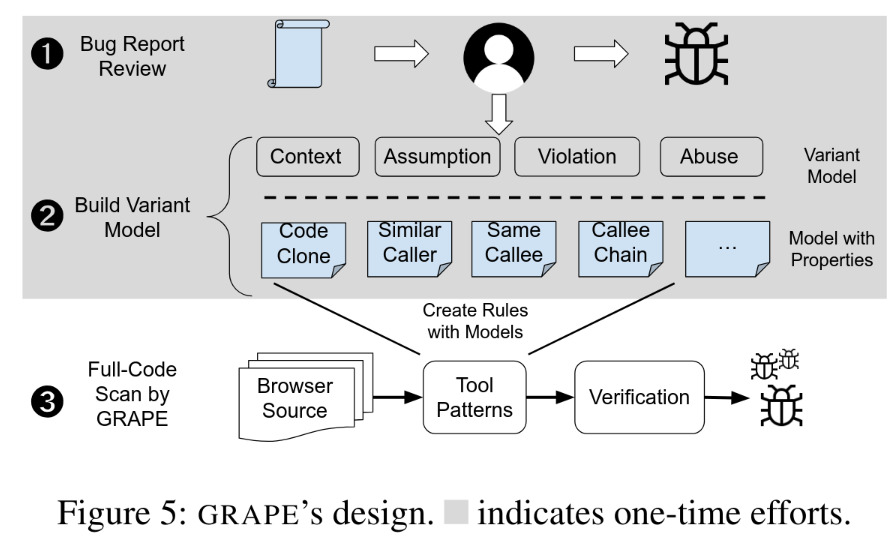
In Grape, we explored this trade-off. When applying variant analysis to large code bases, we observe three main challenges: (i) code size, (ii) cross-context interactions, and (iii) cross-domain dependencies that together influence the state of the application and make analysis difficult. Grape therefore applies a structured variant analysis. Instead of creating overly complex patterns, we combine patterns at different levels of abstraction. We break the patterns into (i) context, (ii) assumption, (iii) violation, and (iv) abuse. Together, these indicators allow us to mix and match even complex interactions in the code. The following block gives an example of the different indicators:
// (i) context
void CallbackLayerAnimationObserver::SetActive() {
  weak_this = GetWeakPtr();
  // (iii) violation
  CheckAllSequencesStarted();
  // (ii) assumption
  if (!weak_this) { return; }
  // (iv) abuse
  CheckAllSequencesCompleted();
}
Our implementation leverages SemGrep and combines several patterns to reap bug candidates and then prune them in a second step. This combination of several patterns allows us to increase recall while ensuring few false positives.
Our evaluation discovered 24 confirmed vulnerabilities in Chromium, a 46M LoC code base, receiving 17,500 USD in bug bounty. We additionally discovered bugs in Firefox and Safari due to their use of shared libraries.
Grape was published at Usenix WOOT'26 and received the best paper award. The main student behind the work is Han Zheng who deserves most of the credit for the work.